The Tudor forts, gun by gun.
Why Henry VIII built a chain of gun forts round the coasts of England, how their round towers, bastions and gunports worked, and what happened to them afterwards, from Deal, Walmer and Sandown to Pendennis, St Mawes, Portland, Hurst, Calshot, Camber, Yarmouth and Upnor. Every fact is checked against English Heritage and the UK government, and where sources disagree we show each one.
The short version
Between 1539 and 1547 Henry VIII made a national plan to defend England against invasion by powerful Catholic forces in Europe. English Heritage: Tudors: War He built over 30 new gun forts to stop enemies capturing harbours and estuaries along the east and south coasts. English Heritage: Tudors: War
The big forts had squat, rounded shapes, built to fire guns in every direction. English Heritage: Tudors: War The circular shape and several tiers let the guns fire outwards all the way round. English Heritage: Local Learning, Pendennis and St Mawes Castles
English Heritage’s Deal pages say these forts are known as Henrician castles or “device forts”. English Heritage: Deal Castle, history and stories The forts ran in a chain from Hull in the north-east round to Milford Haven in Pembrokeshire. English Heritage: History of Hurst Castle
The forts turned out to be a dead end in fort design, but they were strong obstacles for many years. English Heritage: Tudors: War The angle bastion became the main way to build forts for the next 300 years. English Heritage: Tudors: War
Start exploring
How real was the threat?
The pope urged them to invade England to punish Henry VIII. English Heritage: History of Walmer Castle Portland’s history page says how real the invasion threat was is debatable. English Heritage: History of Portland Castle
Our sources describe the threat in different ways: see when sources disagree.
And how many forts were there?
Local Learning says over 30 forts were built, the largest coastal defence programme in England since the Roman period. English Heritage: Local Learning, Pendennis and St Mawes Castles By the end of Henry’s reign in 1547, Deal was one of 42 new artillery forts protecting ports, anchorages and estuaries. English Heritage: History of Deal Castle
Our sources give different numbers: see when sources disagree.
Enjoying the forts? Help keep the lights on.
This site is hand-built, fact-checked and free to read. If a fact, a game or one of Useless’s notes made you smile, a little support keeps it going and helps the network grow.
Tudor forts printables
Fact-checked PDFs in A4 and US Letter, for ages 7 to 11, ages 11 to 14, families, history fans and visitors.
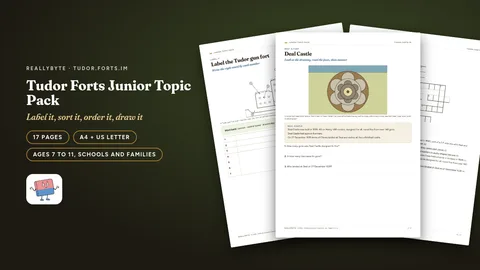
Tudor Forts Junior Topic Pack
Ages 7 to 11, schools and families
Meet Deal Castle, label a Tudor gun fort, three fort shapes, Tudor-times-or-after sorting cards, put-it-in-order date cards, a true-or-false quiz, a crossword where every answer is a real fact, a word search, a comic strip, a fort to colour, a certificate and a full answer key
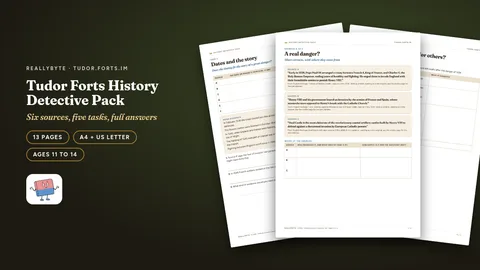
Tudor Forts History Detective Pack
Ages 11 to 14
Why did Henry VIII build his coastal forts, and how real was the threat? Six short sources with their provenance, an evidence table, a dates task, questions the sources answer differently, and a judgement task, with full answers
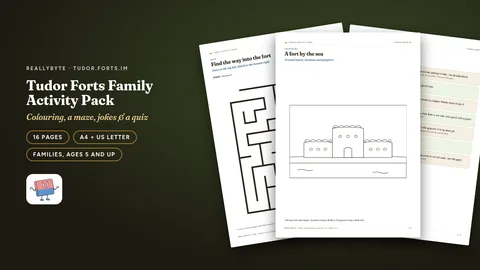
Tudor Forts Family Activity Pack
Families, ages 5 and up
Colouring pages, a fort maze, spot-the-difference, design your own fort, Useless the Eraser’s fort jokes and a 20-question quiz to do together
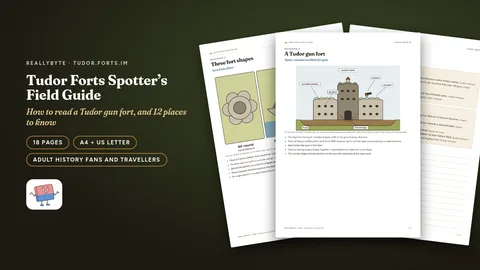
Tudor Forts Spotter’s Field Guide
Adult history fans and travellers
How to read a Tudor gun fort, towers, bastions and gunports, round forts and angle bastions, 12 places with what English Heritage says about them, a timeline, open questions and a checklist
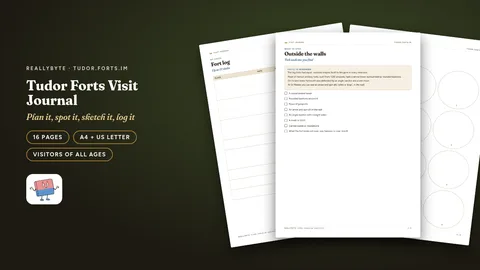
Tudor Forts Visit Journal
Visitors of all ages
Before-you-go checklist, what-to-spot tick lists for outside and inside the fort, six sketch pages, a log for up to 12 visits, and a visit stamps page
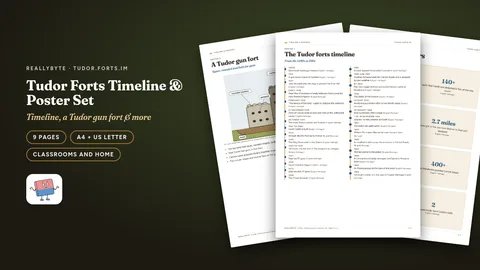
Tudor Forts Timeline & Poster Set
Classrooms and home
Six poster pages: a timeline from the 1490s to 1984, a Tudor gun fort, three fort shapes, crossfire across a harbour, the angle bastion, and the forts in numbers
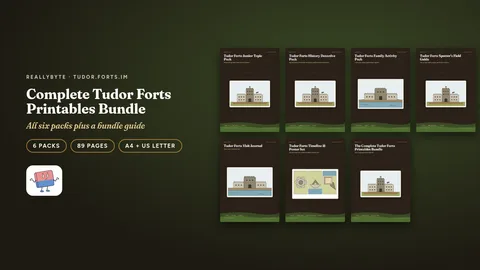 Best value
The Complete Tudor Forts Printables Bundle
All six packs plus a bundle guide, A4 and US Letter, in one download. $12.99 instead of $26.44 bought separately.